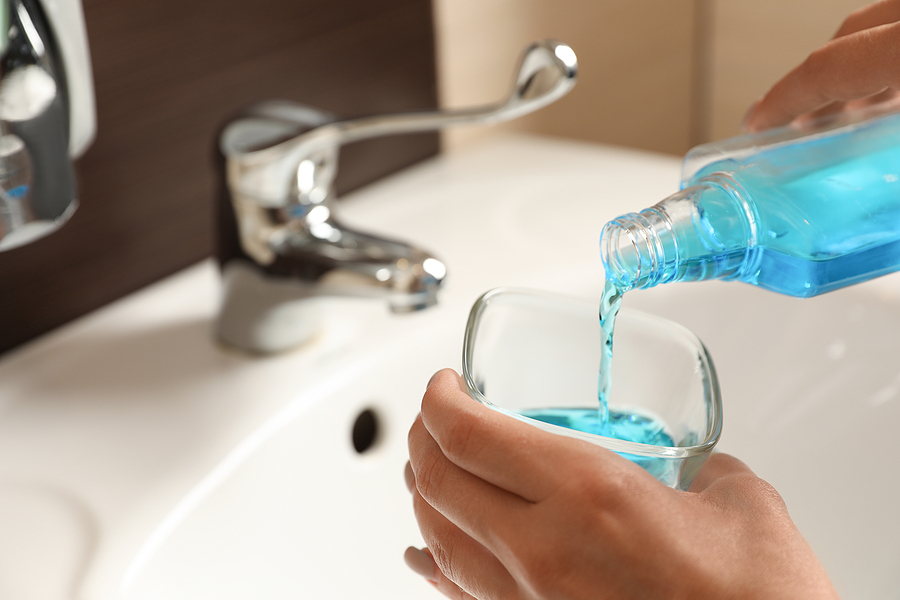
No, mouthwash cannot replace flossing, and you really do need both. However, the reasoning behind that answer is more nuanced than a simple yes or no. Mouthwash and flossing work through fundamentally different mechanisms and address different surfaces in the mouth.
For example, mouthwash delivers antimicrobial agents and fluoride to accessible oral surfaces to reduce bacterial levels in the mouth. Flossing physically disrupts and removes the adherent plaque biofilm from the surfaces between teeth and just below the gumline.
Neither fully substitutes for the other, and the clinical research on oral hygiene outcomes consistently shows that combining both produces better results than relying on either alone. Let’s discuss.
Understanding What Mouthwash Does and Doesn’t Do
Depending on the formulation, mouthwash delivers antimicrobial agents, fluoride, or both across the surfaces of the teeth and soft tissues of the mouth. The active ingredients in therapeutic mouthwashes often include:
- essential oils
- chlorhexidine
- cetylpyridinium chloride
- fluoride
These ingredients reduce bacterial levels, inhibit new plaque formation, and support enamel remineralization. Understanding what mouthwash is designed to do makes it easier to understand where it fits in a daily routine and where it doesn’t.
Advantages of Using Mouthwash
Teeth account for roughly 20% of the total oral surface area. The remaining 80% are reservoirs for bacteria that can reattach to tooth surfaces within minutes of brushing. So, one of mouthwash’s most significant advantages is its reach.
Swishing mouthwash allows active ingredients to contact these areas in a way that no mechanical cleaning method can. This whole-mouth antibacterial effect is genuinely valuable, and it’s the primary reason mouthwash has a place in a complete oral hygiene routine, even for patients who brush and floss thoroughly.
Mouthwash Limitations
What mouthwash cannot do is physically remove the biofilm that has already adhered to tooth surfaces. Plaque is a structured biofilm that adheres to tooth surfaces through a matrix of bacterial proteins and polysaccharides. Once established, it is less susceptible to antimicrobial agents than free-floating organisms.
The ADA is explicit that mouthwash is not a substitute for brushing and flossing. It’s merely an adjunctive tool that adds a chemical layer of protection on top of mechanical cleaning, not a replacement for it.
Understanding What Floss Does and Doesn’t Do
Interproximal biofilm is more prevalent, more acidogenic, and more readily forming than biofilm on other oral surfaces. That’s why interdental cleaning has its own dedicated recommendation separate from brushing. Flossing physically disrupts and removes plaque biofilm from the surfaces of teeth and from just below the gumline.
Brushing alone does not significantly disrupt biofilm at these sites, regardless of method, brush type, or duration. The surface geometry doesn’t allow it. Consult your dentist to learn about proper flossing techniques.
Advantages of Flossing
The most significant advantage of flossing is access. The contact points between adjacent teeth and the gumline are the two sites where a disproportionate share of dental disease originates, and they’re surfaces that no other home care method addresses as adequately.
Flossing is also the only home care method that can reach just below the gumline when used correctly with the C-shape technique. Floss also conforms to the contour of each tooth and clears biofilm from this critical area in a way that no rinse or brush geometry can replicate.
This subgingival reach is particularly important for patients at elevated risk of periodontal disease, where the difference between a clean sulcus and one with established biofilm can determine whether early inflammation progresses.
Flossing Limitations
Flossing’s limitations are real and worth understanding clearly, because they explain why it works best as part of a complete routine rather than a standalone practice. The most significant limitation is that flossing addresses only a narrow set of surfaces. It cleans the faces of teeth and the sulcus, but nothing else.
The soft-tissue surfaces of the mouth are entirely outside the scope of flossing. Bacteria residing on these surfaces continuously recolonize tooth surfaces, which is why flossing without brushing and rinsing leaves most of the oral environment unaddressed.
How Mouthwash and Floss Work Together
Asking whether mouthwash can replace flossing is the wrong question. Mouthwash and flossing address different surfaces through different mechanisms, and the research on oral hygiene outcomes shows that the combination outperforms either method alone.
Each method creates conditions in which the other is more effective:
- A mechanically cleaned mouth provides cleared surfaces for mouthwash active ingredients to act on
- A reduced bacterial environment makes the biofilm that reforms between cleaning sessions less pathogenic when it does return.
Multiple studies that have included a brush-floss-rinse arm have consistently found that the three-component combination outperforms any two-component regimen on measured oral health outcomes, including plaque scores, gingivitis indices, and bleeding on probing.
Want to know more? Book an appointment with Dickinson & Branon Dental Care today to develop a personalized oral health care plan with an experienced team.
The Importance of Brushing, Flossing, and Rinsing
Brushing, flossing, and rinsing with mouthwash are not three versions of the same thing. There are three distinct interventions that address different surfaces, through different mechanisms, and with different clinical effects.
The reason all three are recommended is that none of them fully covers what the others do. For example, brushing addresses the facial, lingual, and occlusal surfaces of the teeth. Flossing addresses the surfaces that brushing misses, and mouthwash addresses what neither brushing nor flossing can reach: the soft-tissue surfaces of the mouth.
When done correctly for two minutes twice a day, brushing removes the majority of plaque from surfaces and delivers fluoride to the enamel. It does not, however, clean the proximal surfaces between teeth or the gumline. Meanwhile, adding flossing to a brushing routine increases biofilm disruption more than brushing alone.
The tongue, cheeks, palate, and gingival tissue collectively account for roughly 80% of the oral surface area, and bacteria residing on these surfaces recolonize tooth surfaces between cleaning sessions. Thus, a therapeutic mouthwash can help reduce this bacterial reservoir and inhibit early biofilm reformation on surfaces that have just been cleared by brushing and flossing.
Together, the three practices create a routine in which each component reinforces the effectiveness of the others.
- A mechanically cleaned mouth gives mouthwash active ingredients cleaned surfaces to act on.
- A reduced overall bacterial environment makes the biofilm that reforms between sessions less pathogenic.
- Consistent daily maintenance at home is what makes the twice-yearly dentist visit worthwhile.
None of the three is optional, and none fully substitutes for the others.
Tips for Using Mouthwash and Floss Properly
Knowing that both mouthwash and flossing are important is one thing. Using each correctly to get the clinical benefit they’re capable of providing is another.
The most widely supported sequence is to floss first, then brush, then rinse with mouthwash. Flossing first dislodges debris and disrupts interproximal plaque, allowing the toothbrush to remove loosened material from the broader tooth surfaces more effectively. Brushing second deposits the fluoride from toothpaste onto enamel surfaces.
Using mouthwash last allows active ingredients to contact the freshly cleaned surfaces without being immediately diluted or displaced by subsequent mechanical cleaning. This sequence maximizes the contribution of each step rather than working against it.
Flossing Tips
The C-shape technique is what the ADA recommends, and for good reason. It involves curving the floss around the base of each tooth and, independently, guiding it gently below the gumline on each proximal surface.
A straight-through sawing motion passes floss between two teeth without conforming to the surface of either one, leaving a significant portion of the proximal surface and the sulcus uncleaned. Detailed guidance on correct flossing technique is available from the ADA or Dickinson & Brannon Dental Care.
A few additional technique points worth applying:
- Use about 18 inches of string floss per session, and move to a clean section between each tooth.
- Ease the floss into each contact gently rather than snapping it through, as forcing it in can lacerate the gum tissue and cause recession.
- Work the floss up and down the side of each tooth separately, not just through the middle of the gap.
- Don’t skip the back surface of the last molar on each side.
Mouthwash Tips
Using mouthwash correctly is simpler than flossing, but still involves a few meaningful variables. The most important thing is product selection. So, choose a therapeutic mouthwash with documented clinical evidence rather than a cosmetic product marketed primarily for breath freshening or teeth whitening.
Look for the ADA Seal of Acceptance, which indicates the product has been evaluated for safety and effectiveness. Or consult your dentist for more information. Beyond that:
- Swish for the full duration listed on the product label to allow active ingredients adequate contact time with oral surfaces
- Don’t rinse with water after using mouthwash, since it dilutes the active ingredients
- If using a fluoride mouthwash, use it at a separate time from brushing to maximize fluoride exposure
- Store mouthwash at room temperature and check the expiration date
For best results, treat each step as a distinct practice with its own role, not interchangeable parts of the same routine. Then schedule your biannual dental checkup to track progress and catch issues before they escalate.
When to Call Your Dentist
Mouthwash and flossing are home care tools. That means they help maintain oral health between professional visits, but they don’t replace what a clinical examination and professional cleaning provide.
The 2-2-2 Rule exists because home care and professional monitoring are designed to operate together. Your daily routine of brushing, flossing, and rinsing maintains the baseline between appointments; your twice-yearly visits assess it, correct it, and address what home care cannot.
Moreover, there are situations in which changes in your mouth warrant calling your dentist before your next scheduled appointment. Waiting until a routine visit to address a developing problem is sometimes appropriate, and sometimes not. Knowing the difference matters.
Contact Dickinson & Brannon Dental Care if you notice any of the following:
- Bleeding gums that persist for more than one to two weeks of consistent flossing
Some initial bleeding when restarting a lapsed flossing routine is normal as gum tissue adjusts, but bleeding that doesn’t resolve is a clinical sign that warrants evaluation.
- Gum recession, increased sensitivity at the gumline, or teeth that appear longer than they used to
These can indicate attachment loss that needs professional assessment rather than a change in home care tools.
- Persistent bad breath that doesn’t improve with brushing, flossing, and mouthwash
Chronic halitosis often has a clinical cause, including periodontal disease, dry mouth, or other conditions, that home care alone won’t resolve.
- Visible changes in soft tissue
Sores, white or red patches, or lesions that haven’t healed within two weeks warrant examination, regardless of whether they cause discomfort.
- Pain or sensitivity when flossing at a specific tooth
This can indicate a cavity at the contact point, a cracked tooth, or a failing restoration.
- Any sudden change in how your teeth feel when biting or chewing, or a shift in how your teeth fit together
Most dental problems that are caught at a routine appointment are simpler, less expensive, and less uncomfortable to treat than the same problems caught when a patient seeks care for pain. Consistent home care and consistent professional visits are not alternatives to each other, so book your appointment today.
Takeaway
Mouthwash and flossing are not interchangeable, and the question of which one to use misses the point. They address different surfaces through different mechanisms, and the evidence for using both consistently is stronger than the evidence for either alone.
Brushing cleans the broad surfaces of the teeth. Flossing cleans the proximal surfaces and sulcus that brushing can’t reach. Mouthwash reduces the bacterial load on soft-tissue surfaces that neither brushing nor flossing addresses. Each component fills a gap left by the others.
A complete routine followed daily, even imperfectly, produces better long-term outcomes than an occasional perfect one. If you have questions about whether your current routine is working or which mouthwash formulation is right for your situation, bring it up at your next appointment.